Noah and Gilgamesh
When reading the Epic of Gilgamesh, there are so many interesting parallels with the biblical narrative, and I would say not necessarily contradictory.
What are the parallels, and what did I learn from listening to The Epic of Gilgamesh?
Parallels
Before reading the story of Gilgamesh, I thought that people were saying that Gilgamesh was an alternative version of the ark and flood story, and it was merely a contradictory alternative version. But I was really surprised to find that the character of Noah is in the story as someone Gilgamesh needs to go and see and so many of the details line up between the narratives!
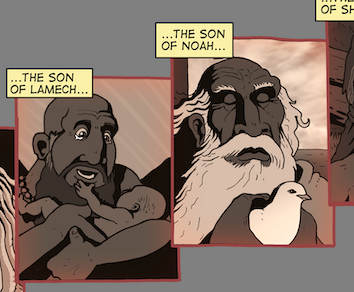
Image from the Gospel of Luke: Word for Word Bible Comic
NOAH: In the story, Noah is called Utnapishtim. The man who built an ark and survived the flood. I found it fascinating that Gilgamesh had to seek out Utnapishtim for his wisdom, and that the account of what happened to Utnapishtim is extremely close to the Genesis account.
One difference between the stories seems to be that Utnapishtim is considered to have been granted immortality by the gods, whereas Noah is mortal. However, Noah lived 950 years, so it makes sense that his contemporaries would consider him immortal. (Genesis 9:28-29)
The name Utnapishtim is obviously different to Noah, but it means "he has found life", so it would seem to be more of a title than a name anyway.
THE ARK: The ark is described in some detail, as in the biblical narrative, including its size, dimensions, materials, and even the number of decks. It was filled with many animals, including sacrificial animals. The dimensions were different, however: the biblical ark was a viable vessel (approx. 450–500 ft long), while the other was an impractical cube (200 feet on each side). Both were constructed from timber and sealed with bitumen.
Image from the Gospel of Matthew: Word for Word Bible Comic
THE FLOOD: It was interesting that in the epic, although it attributes it to other gods, it talks about the waters coming from above and from below, just as it does in the Bible. (Gen 7:11)
The duration differs, however, with the Genesis flood lasting over a year, with 40 days of downpour and the Gilgamesh flood lasting only six days and seven nights.
THE TELLING: In the epic, Utnapishtim recounts what happened during the flood, including sending out two birds that returned empty-handed, and then the bird that found land. Although the actual types of birds in Gilgamesh are dove, swallow, and raven, rather than raven, dove, and then a dove.
Utnapishtim also describes giving a sacrificial offering to God after the flood, which is described as having an aroma pleasing to the Gods. (See Gen 8:21)
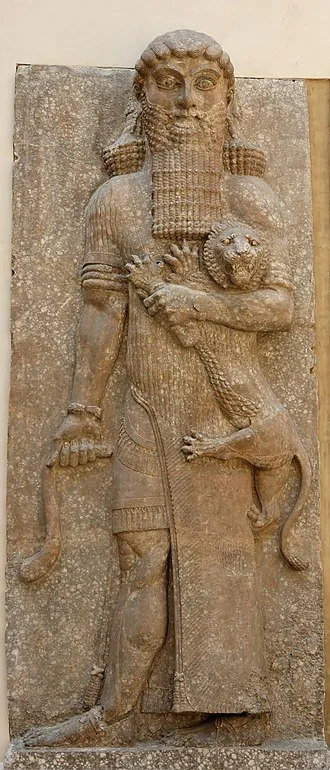
Possible representation of Gilgamesh (713–706 BC). Look at his size compared to the adult lion he holds.
NEPHILIM: There's a fascinating correlation between the fact that in Genesis there are Nephilim, heroic giants (Gen 6:4), created by the union of women with “the sons of God” a.k.a. fallen angels, and that in the epic, Gilgamesh is a super strong giant, 18 feet tall with armour and weapons 10x the weight of normal. He is considered to be three-quarters “divine”, a.k.a., his parentage including the “gods” of the Sumerians.
GILGAMESH’S MORALITY: I was also very surprised that, as the “hero” of the story, he couldn't be further from being heroic. He's introduced as a king who steals what he wants, rapes women, kills boys and is known to be unreasonable. These qualities are lauded in the story. Even once he begins questing, his objective is to slay a draconic beast, but it’s not to help anyone, but to gain renown. Some reference his great friendship with Enkidu as a good quality, but his friend is of no greater character than Gilgamesh himself. They are depicted as deeply devoted soulmates who share an intimate bond, described as loving each other "like a wife".
Gilgamesh is arrogant, and when the goddess Ishtar/Inanna tries to seduce him, rather than simply rejecting her, he heaps her with endless abuse. Then, later in the story, he prays to her and asks for her help.
It was very interesting to me to see the pre-mosaic morality expressed in this story.
—-
This list is not exhaustive. There are lots of little parallels and differences to explore, but as the story is not so very long and can be listened to within two hours, I would encourage you to do so, especially if you're familiar with the Genesis story.
If you're considering listening to the story with children, be warned that it is rather lewd towards the beginning and has a lot of adult themes (like Genesis)
The epic is written in a much more poetic style than Genesis, not only with repetition but also with the level of exaggeration, saying Gilgamesh and Enkidu travel 1,000 miles in a day and carry a sword weighing 200 lb. As such, the details that clash, like the cube-shaped ark and length of the flood being only several days, I see as the same poetic hyperbole.
Listen
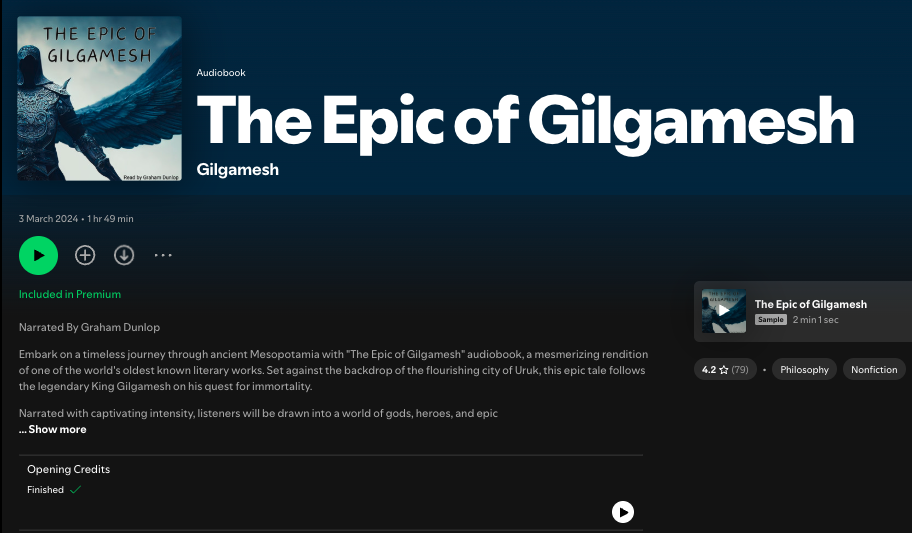
The Epic of Gilgamesh is available to stream on Spotify Premium. It only takes one hour and forty-nine minutes, including the Intro.
I found this a really accessible way to hear the story, and the repetition of the verses makes more sense in an oral version.